Where Ice Meets Infinity

Camille Dubois
| 26-05-2026
 · Travel team
Readers, the world's largest island is also its emptiest.
Greenland stretches across 2.16 million square kilometers of ice sheet, fjord, tundra, and rock, yet holds a population smaller than most city neighborhoods—roughly 56,000 people in total.
The scale here is not human-sized. Icebergs drift through fjords like floating cathedrals of blue ice.
Across frozen seas, teams harnessed to wooden runners glide beneath northern lights that ripple green and violet across half the sky. Reaching this place demands planning, flexibility, and a true taste for raw, untamed wilderness—but what awaits on the far side of that effort is unlike anything else on Earth.
Ilulissat Icefjord
The UNESCO-listed Ilulissat Icefjord on Greenland's west coast is the single most visited natural attraction in the country, and for obvious reasons. The Sermeq Kujalleq glacier—one of the most productive on Earth—calves massive icebergs into Disko Bay at a rate of roughly 20 billion tons of ice per year. Boat tours navigating among these icebergs cost approximately $100 to $250 per person for two- to three-hour excursions.
The marked hiking trails along the Icefjord rim are completely free, well-maintained, and deliver views of ice formations that dwarf even the largest boats passing below. The Icefjord Centre, opened in 2021, provides exhibitions on glaciology and Arctic ecology.
Greenland
Northern Lights
Greenland's minimal light pollution and high latitude make it one of the world's finest locations for viewing the aurora borealis. The northern lights are visible from late September through early April, with March often delivering the best combination of dark skies, stable weather, and high geomagnetic activity.
Guided aurora-hunting tours by snowmobile or boat cost approximately $100 to $250 per person. Many hotels and guesthouses in Ilulissat offer aurora wake-up calls—staff will knock on your door if the lights appear while you sleep. Hotel Arctic's famous "Aurora Cabins" provide glass-walled rooms specifically designed for overnight sky viewing.
Getting There
Most international travelers fly from Copenhagen to Nuuk (approximately 5 hours via Air Greenland), then connect on a domestic flight to Ilulissat (roughly 45 minutes). Round-trip flights from Copenhagen to Ilulissat range from approximately $900 to $2,300 depending on season and advance booking.
Summer routes from Reykjavik, Iceland, occasionally offer direct flights to Ilulissat. Weather-related flight delays and cancellations are a genuine reality in the Arctic—building at least one or two buffer days into any itinerary prevents missed connections and reduces stress significantly.
Where to Stay
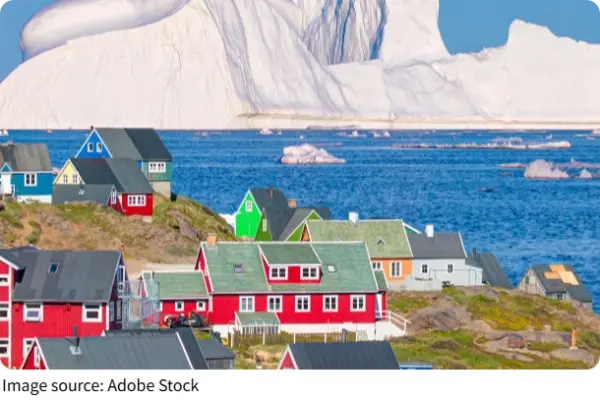
Ilulissat offers accommodation ranging from guesthouses to premium hotels. Budget guesthouses and hostels start from approximately $100 to $200 per night. Standard hotels including Hotel Hvide Falk and Best Western Plus Ilulissat range from $200 to $350 nightly. Hotel Arctic—Greenland's most famous property—commands premium rates for its iceberg views and Aurora Cabins.
Self-catering apartments and vacation rentals with kitchen facilities are available and help manage food costs, which run high throughout Greenland. A simple restaurant meal costs $20 to $40 per person, while supermarket groceries for self-cooking run 50 to 100 percent more than European mainland prices due to import logistics.
Summer Experiences
From June through September, the midnight sun illuminates Greenland 24 hours a day, enabling hiking, kayaking, and boat tours at any hour. Whale watching excursions in Disko Bay—where humpback and fin whales feed during the summer months—cost approximately $100 to $200 per person.
Kayaking among icebergs with a certified guide runs $80 to $180 for half-day trips. The hiking trails around Ilulissat—including the Yellow Trail (easy, 2.7 km), Blue Trail (moderate, 7 km), and Red Trail (challenging, 15 km)—are all free and open throughout the summer season.
Practical Essentials
The currency is the Danish Krone (DKK). Credit cards are accepted at hotels, restaurants, and larger shops, but cash is essential for smaller vendors and settlements. Travel insurance covering weather-related disruptions and emergency medical evacuation is strongly recommended—the nearest major hospital facilities are in Nuuk.
Mobile coverage exists in towns but disappears in the backcountry. Pack high-quality thermal base layers, waterproof outer shells, UV-blocking sunglasses (essential for ice glare), and a reusable water bottle—tap water throughout Greenland is safe and some of the purest on the planet.
Lykkers, Greenland does not ease you in gently. It confronts you with scale—icebergs the size of apartment complexes, silences that press against your eardrums, and skies that shift from pitch black to electric green without warning. It is not a destination for everyone, but for those who feel drawn to the edge of things, there is no edge more dramatic or more deeply rewarding. What would it take to convince you to stand on the shore of an Arctic fjord and watch the ice drift by?